
Just a Phase
On Walking Toddlers & Chasing Parents

Hey. I hope you enjoy this tale of toddler locomotion. If you want to keep these coming, consider subscribing. If you really wanna go the extra mile, consider keeping me caffeinated.
Cheers!
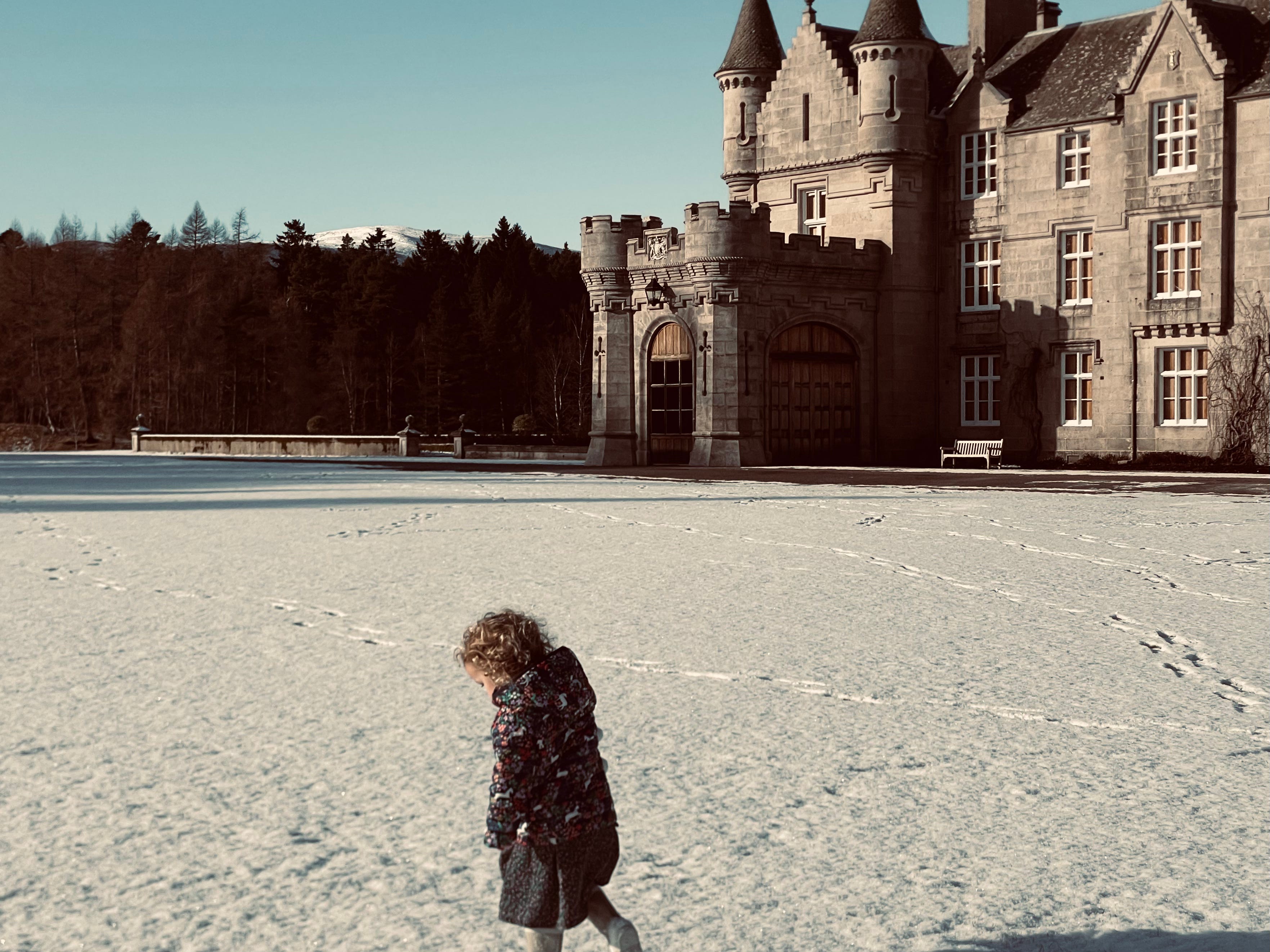
Not a day goes by that I don’t regret teaching my daughter to walk. It started off innocent enough: a few hilariously inept steps here and there, usually ending with her on her ass. But she improved quickly, and she quickly got fast. By the time we realized our mistake, it was too late to slow her down. She was mobile, and, like every other human in history, she learned to use her legs before she learned to use her brain. We have been paying for this mistake ever since.
An illustrative example happened this week at the supermarket. We had trudged half a mile in the rain to get “just a few things” for supper, but ended up over-filling two large tote bags. As the clerk rang up the never-ending stream of items, I thought I was going to have to start filling my jacket pockets. But once I paid for everything and hoisted the bags — one in each hand — from the checkout counter, I realized the true nature of my mistake. It wasn’t just the heavy bags I’d have to carry home. It wasn’t just the possibility Felicity would refuse to walk, and I’d have to carry her and the heavy bags home. The real problem was holding these bags — so full they couldn’t stand on their own without spilling — limited my ability to react to toddler shenanigans. I have a feeling Felicity and I realized this at the exact same moment. The game was on.
We made eye contact. I was completely vulnerable, but I tried to stand my ground. “Let’s go,” I said, thinking I could proactively redirect her. No dice: she didn’t move. I could see the gears turning in her head as her grin turned from innocent to shit-eating. She knew she had me. She knew, just as I did, that if she ran away I’d never stop her in time. She knew I’d never just drop my grocery bags and let everything tumble out of them. “Wait!” I said before she even moved. “Do you want some chocolate?” But it was too late: she was heading full-throttle towards Produce.
“Fuck,” I thought, “I’m never gonna catch her.” Because I was surrounded by people, I couldn’t yell. If I yelled, I would appear angry. If I got angry, they’d all know I had lost control. Appearing in control is much more important socially than actually being in control, so I kept quiet. And I couldn’t have grabbed her because I had nowhere to put down my over-filled tote bags. The idea of all my impulse purchases (on-sale canola oil, tinned herring, little sugary cakes) falling all over the floor while I scooped up my psychopath of a child was too much to bear. No, I had to bring the bags with me. But I also couldn’t run. My kid is like a dog. If I run, she’ll think it’s a game and run faster. So I walked briskly and quietly, trying to maintain my cool, pleading with my toddler through gritted teeth.
I spotted her behind a box of potatoes. I could see the edge of her shit-eating grin. I faked a laugh: “Alright, Flicky, let’s go sweetheart.”
“Not yet,” she yelled as she ran to the next aisle over.
I understand judgement is something that happens solely in the mind of others, but I’m pretty sure that if there is enough judgement in one space — say the produce section of a supermarket — it can actually create a physical sensation in the person being judged. It didn’t matter if people were chuckling, snorting, or ignoring the situation altogether. They all thought the same thing: look at this sorry man who has no idea what he’s doing. The judgement hurt, but yelling or running or displaying any acute emotion whatsoever would only have made it worse. So I just shrugged and continued stalking my child through the entire supermarket until she made her fatal mistake — the cleaning aisle. There are never customers in the cleaning aisle. I dropped the bags and sprinted towards my target. I scooped her up, used my feet to push toppled-over foodstuffs back into my bags, and marched her out the door.
“I’m never putting you down again,” I told her on our way home, carrying her and all the shopping the half-mile home in the rain. I didn’t mean it in a nice way.
“We playin’ games!” she responded, unfazed.
Toddlers being able to walk is a bit like teenagers being allowed to smoke or the elderly being allowed to drive. Sure, they can — as in they have the necessary physiological equipment — but is it really a good idea? If aliens from a more orderly part of the galaxy came to Earth and saw that human children are given access to near-complete ambulatory freedom before they learn to fear (and thus avoid) death, they would be right to wonder how we ever made it out of the caves and into space.
There is not a road too busy, a puddle too deep, or an employees-only area too dangerous for my daughter to toddle directly into. To her, what good is looking at a river from five feet away when she could look at it from the bottom of it? What good is merely walking through a fancy gift shop when she could whirlwind through it and knock over every expensive trinket? What good is simply walking past the giant ice cream cone outside a candy shop when she could sprint over to it and lick it?
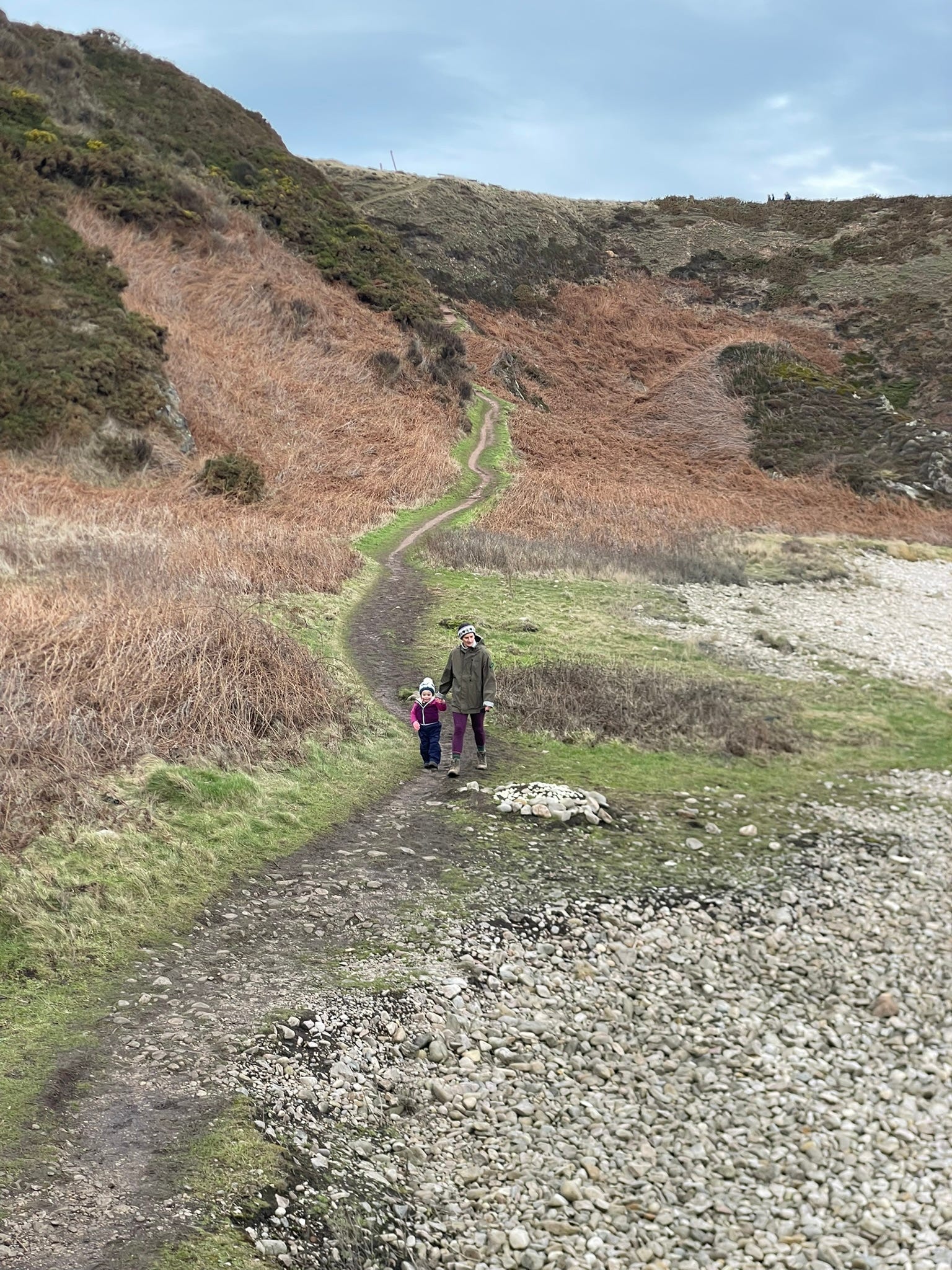
Perhaps the most frustrating thing about her inexhaustible appetite for movement is her unwillingness to wield it productively. Recently, she’s invented a new game. She calls it “Aeroplane,” and it’s simple. She runs circles around our sofa and coffee table as fast as she can. We can’t figure out why she calls it Aeroplane, given that she makes no attempt to mimic the shape or sound of an aircraft. She just silently runs circles for a comical amount of time. Like, 40 laps. When she first started doing this, I thought, “Ah ha! You’ve shown your hand! No more carrying you to the bus stop!”
You can imagine my surprise the next time we went into town and she made it as far as the end of our road before asking — no, demanding — to be carried. My argument involving Aeroplane fell on deaf ears.
But it’s even worse than it sounds. One reason for this is how particular she is about the manner in which she is carried. My preference is for her to sit atop my shoulders. This maximizes long-term back pain, but it is also fast. And in the day-to-day trenches of toddler transport, speed is king (we’re never on time for anything). But Felicity doesn’t have any interest whatsoever in efficiency. Honestly, I think she prefers inefficiency. Thus, she generally demands to be carried in the traditional way but with some caveats. Her recent demand is that I use only one hand to hold her against my side. Given her body mass and my complete lack of hips, this is impossible. What makes it worse is, when she demands I remove one of my hands from her bottom, she says, “It’s too heavy.” Oh, is it? My hand underneath you is too heavy?
Ok, you might be thinking, so you have to carry her everywhere. That’s not that bad, right? Surely it means you can avoid dangerous and tedious distractions?
No. It does not mean that. The issue is she chooses between walking and being carried based exclusively on anti-expedience. If we’re close to home and I have to get supper on as soon as possible and holding her would get us home 10x faster, she will insist on walking. If we’re just beginning our journey and I’d prefer to get there with some arm strength remaining and no sweat stains, she will insist on being carried until the last 5% of the walk, guaranteeing I arrive at our destination in a bad mood.
This was all less of a problem before we moved to a pedestrian-friendly country. What I want to say is that Brits walk everywhere, but that’s not the whole truth: they also walk to nowhere. No British day is considered complete without a long and muddy walk. Oh, and for the Americans reading, it’s important to note that walk in Britain refers to everything from the 5-minute dog jaunt to the week-long cross-country trek. No self-respecting Brit uses the word “hike,” even if it would be a helpful distinction for a hapless American who would like to know what he’s getting himself into.
This obviously took a bit of adjusting. When we moved here, Flick was (and still is) quite well adapted to the car. She can tolerate hours in the backseat, so long as we keep the Super Simple Songs playlist bumping. A walk, however, is a constant struggle spent either standing around waiting for her to finish examining every blade of grass on a trail or running after her before she winds up in the middle of a busy road. It’s here where the conflict arises. The ostensible convenience of walking places forces us outside, but the harsh realities of bringing a toddler anywhere pressure us inside.
It doesn’t help that the western canon is full of big brains proselytizing the philosophical purity of the walk.
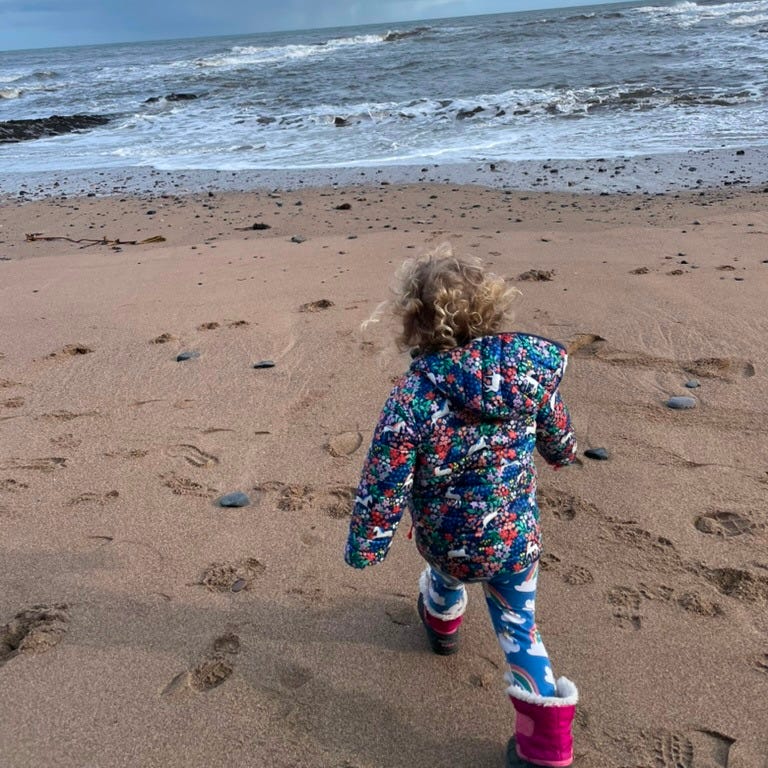
In his charming A Philosophy of Walking, philosopher Frédéric Gros explores the world of peripatetic philosophers as he expounds the infinite virtue of ambling. He quotes Nietzsche:
Sit as little as possible; give credence to no thought that is not born in the open air and accompanied by free movement — in which the muscles do not also celebrate a feast.
And Rimbaud:
Let’s go, hat, greatcoat, both fists in pockets, and step outside
Forward, route!
Let’s go!
And Thoreau:
Let us settle ourselves, and work and wedge our feet downward through the mud and slush of opinion, and prejudice, and tradition, and delusion, and appearance, that alluvion which covers the globe, through Paris and London, through New York and Boston and Concord, through Church and State, through poetry and philosophy and religion, till we come to a hard bottom and rocks in place, which we can call reality, and say, This is, and no mistake.
And Rousseau:
I never do anything but when walking, the countryside is my study.
And summarizes Kant:
He always took the same route, so consistently that his itinerary through the park later came to be called ‘The Philosopher’s Walk’. According to rumour he only ever altered the route of this daily constitutional twice in his life: to obtain an early copy of Rousseau’s Émile, and to join the scramble for hot news after the announcement of the French Revolution.
It’s worth noting, however, that none of these men had children1 .
Needless to say, the poetics of the Great Outdoors is somewhat diminished by the presence of dirty diapers and blood-curdling screaming. I wonder what credence Nietzsche would give to the types of thoughts I have when my daughter is prostrate on the sidewalk wailing. Still, one cannot just remain inside. Inside is, after all, where all the brain-melting distractions live. Outside, though, is where everything else is. It’s actually where the most important thing in the world is: experience.
And as parents, we are little if not curators and chroniclers of experiences. But contrary to the guys quoted above, it’s just not your experience that matters.
The only piece of parenting advice that’s ever meant anything to me is also simple: everything’s a phase. A friend told us this in our living room about a week after our daughter was born. Some phases last longer than others, she told us, but everything changes.
We recite this mantra often. Like suburban King Solomons, our emotions are kept even by the knowledge that all things toddler — the good and the bad — eventually go away. The funny thing is that you often miss the bad stuff as much as the good stuff. It’s no surprise then that my wife and I mourn the loss of all her little mispronunciations. Her doll Susie is no longer “Sua,” the sofa is no longer “sopa,” and the bus is no longer the “fuss.” But what is surprising is how we miss her less adorable qualities.
For example, I had a friend visit two weeks ago, and he spent (god bless him) each day with me and Felicity. In the evenings, my wife was kind enough to let us go out to the pub sans toddler. Sitting down at a table, eating apps and drinking pints, I was struck by how strange it felt to not constantly have somebody siphoning all of my attention. I wondered if this was really what life used to be like. How did I fill all this time? Did I even know I had it?
Every time I’m on the move with my kid, I long for the day when she can just stride beside me, chat, maybe grab a burger and eat it without making an absolute fucking mess of our entire corner of the restaurant. But then where will my irreverent little sidekick be? When she eventually learns to behave in public, she’ll be gone forever. Worse, still, I’m the only one who will keep these memories. This, good or bad, is enough for me to keep us moving.
Of course, adults change, too, but the hard problem of toddler change is that the only people who will ever remember who she once was are the few adults in her life. I can remember who I was five, ten, twenty years ago, and I can talk to people who knew me then about the old days. There will be no late night chats with Felicity where we reminisce about that time she threw a tantrum because the slide was wet because she won’t remember it.
But it gets worse. When exactly a toddler grows up — and is gone forever — is nebulous. It’s like having a friend in town and knowing he’ll just up and leave one day. And when he leaves, he’s gone for good. Thus, a tragedy: you never get to say goodbye to your toddler. One day, they’re just gone. This little monster who accompanies me on every little excursion all day, every day will just sign off, never to be heard from again. And all these little catastrophes in supermarkets, on buses, and at home will only ever live outside of her memory. As caregivers, we’re the sole chroniclers of early childhood. What a strange responsibility.
Stranger still is that all of us stand on this invisible platform, upon stages of life we cannot remember that nonetheless compose our psychic backbones. We were all once toddlers who left without saying goodbye just like we arrived without saying hello. Knowing this probably won’t help me find more joy in all of this, but, contrary to common sentiment, joy doesn’t belong to the parent, anyway. It belongs to the child.
And if her version of joy is supermarket hide-and-seek, so be it. Everything’s a phase. If that isn’t enough, nothing ever will be.
Hey, thanks for reading. If you like my stuff, consider subscribing.
Rousseau technically had children, but he abandoned all of them. Presumably so he could walk more.
“When she eventually learns to behave in public, she’ll be gone forever” hit me hard!
And agreed about the “everything is a phase” advise, except my mantra is “this too shall pass” which makes me feel extra wise and zen when I say it
Something I try to remind my adult self, about me and her, everything’s a phase.