
The Robot Vacuum
On The Removal of Dirt
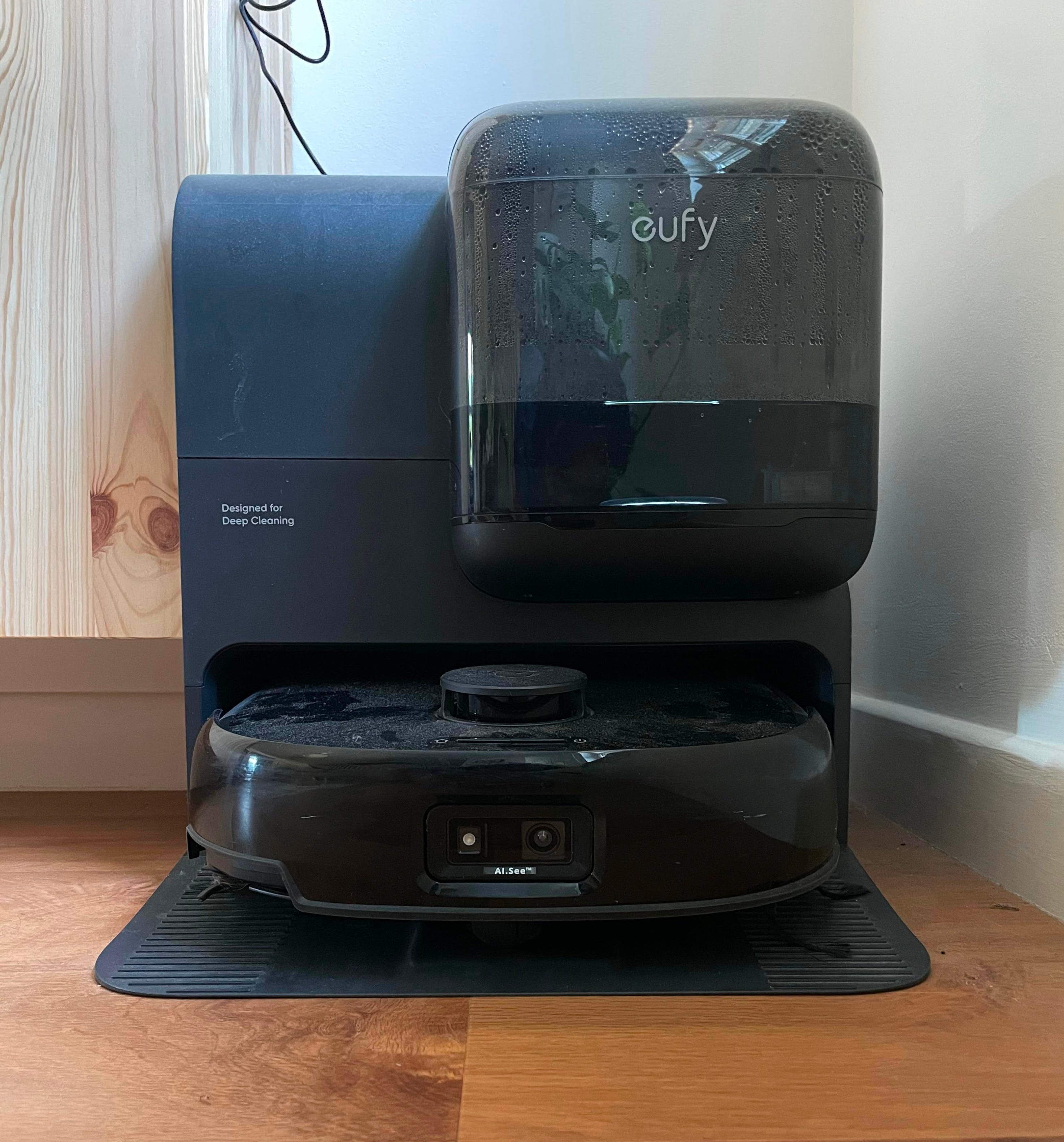
Our Pet Vacuum
I’ll die defending my decision to buy an expensive robot vacuum cleaner. His government name is Eufy E28, but we call him Floris.1 After selling most of our belongings and moving across the pond, he was one of the first things we bought. Before we had a sofa, dining-room chairs, bookshelves, or a bed, we had a giant hockey puck crashing around our house, making a racket, and unsettling the dog. It might seem strange to automate floor cleaning before having a place to sit and eat dinner, but getting Floris early turned out to be a blessing.
Something I did not account for when I purchased him was scale, particularly vis-à-vis his adorable robot house. I was aware he came with such a domicile, but I figured it was little more than a landing pad for him to get a little R&R. But, of course, I got coaxed up the feature ladder until what got delivered was less a robot vacuum and more a robot custodial engineer, complete with a two-story town house.
The problem is Reddit. I always start off just wanting a fairly basic thing, but then head over to the appropriate subreddit for some research. Before I know it, I’m looking at spreadsheets comparing features. The first thing I discovered this time was that I didn’t need a robot vacuum cleaner: I needed a robot vacuum cleaner that also mops. But I didn’t just need a robot vacuum cleaner that also mops, I needed one that self-cleaned the mop. Mops get dirty, and do I really want to be cleaning them myself? But, if it self-cleans its mop, it also needs to auto-dry it, or else it’ll get moldy. Then, of course, there’s auto-emptying dust collection. I can’t be emptying that thing twice a day. May as well get LiDAR sensors and an HD camera while I’m at it. Oh, and look, what about a detachable upholstery cleaner? In this manner, what started as a quick couple-hundred bucks turned into a mortgage-sized investment.
And mortgage is a good metaphor. His adorable robot house, in square footage, would be the envy of a Manhattan-based intern. It didn’t matter. A percentage of our parlor was a small price to pay for automatically cleaned floors. So, I wasn’t fazed when my wife’s only comment was, “I didn’t realize he’d be so big.” I merely explained that our empty home meant we could furnish it around the needs of our new robo-maid. So, we found a nice, cozy corner by the window to station him, filled up his various reservoirs with soap and water, attached his vacuum bag, plugged him in, downloaded the app, and we were off to the races.
The racetrack, it turns out, is also a good metaphor because, if Floris is anything, he’s loud. There’s the obvious noise that comes from him whizzing around our house cleaning up after us. But then there’s the jet-turbine, ear-drum-splitting racket of him emptying his dust bin, which he does twice per cleaning. Then, he has to clean his mops, which is also loud. Then, of course, he dries his mops, which literally takes four hours and produces one of those white-noise type sounds whose deafening presence you only notice once it abruptly stops. Once he’s done with all that, he simply sits in our living room taking up space.
Robot vs. Toddler
The truth is I knew my wife wouldn’t be a big fan of our new roommate, with all his noise and mass. I accounted for that but figured she’d come around once she saw our pristine, glistening, eat-off-able, robot-cleaned floors. I was, however, less prophetic when it came to Floris’s relationship with Felicity, our toddler. I’m not sure how I expected her to react, but her take on the robot is extreme ambivalence, like a love-hate, afraid-obsessed kind of thing. What’s funny is how clearly she vocalizes her own internal conflict. “Let’s do the robot!” she’ll say. Then, in the next breath, she’ll switch sides and say, “I don’t wanna do the robot.”
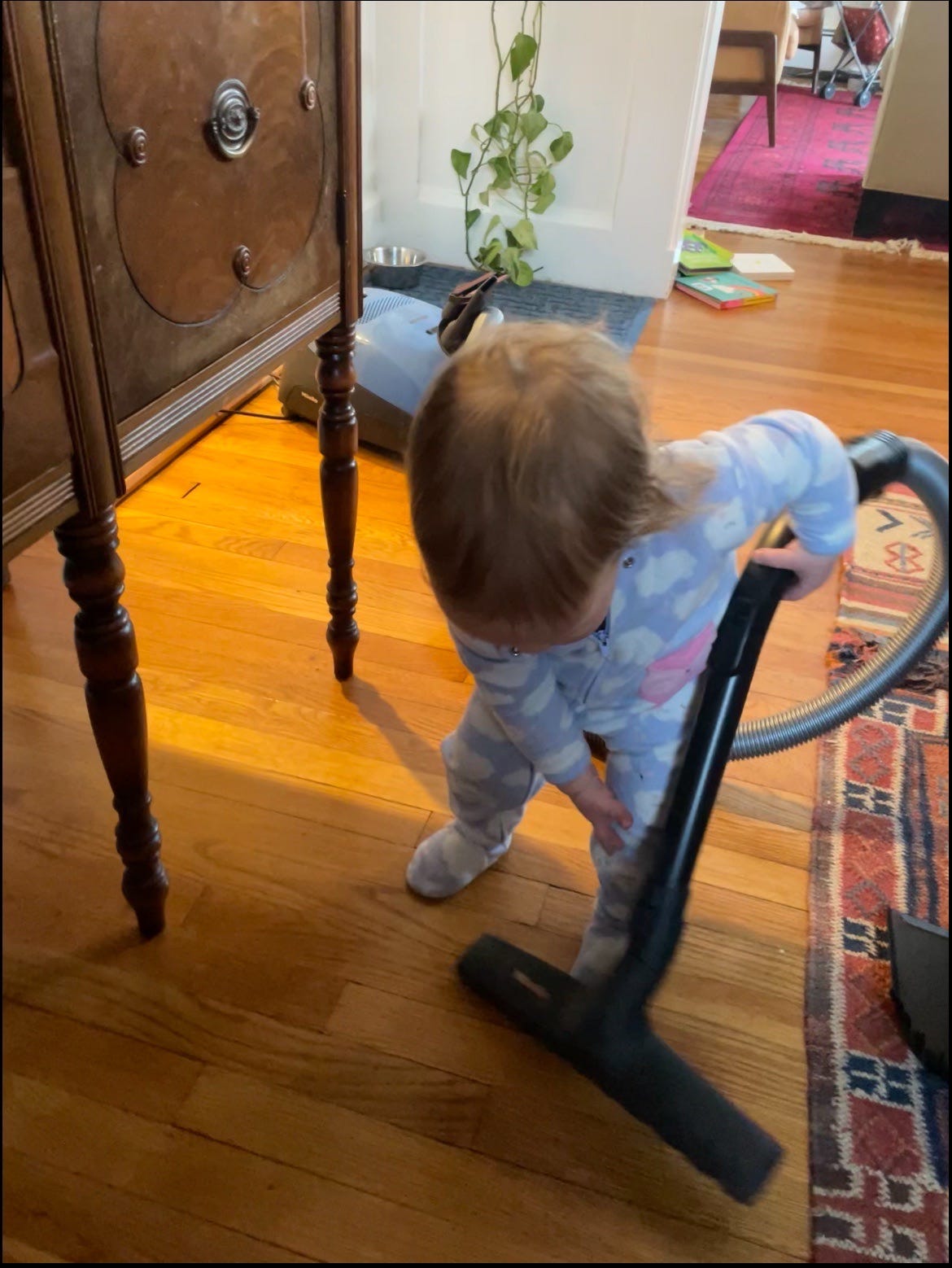
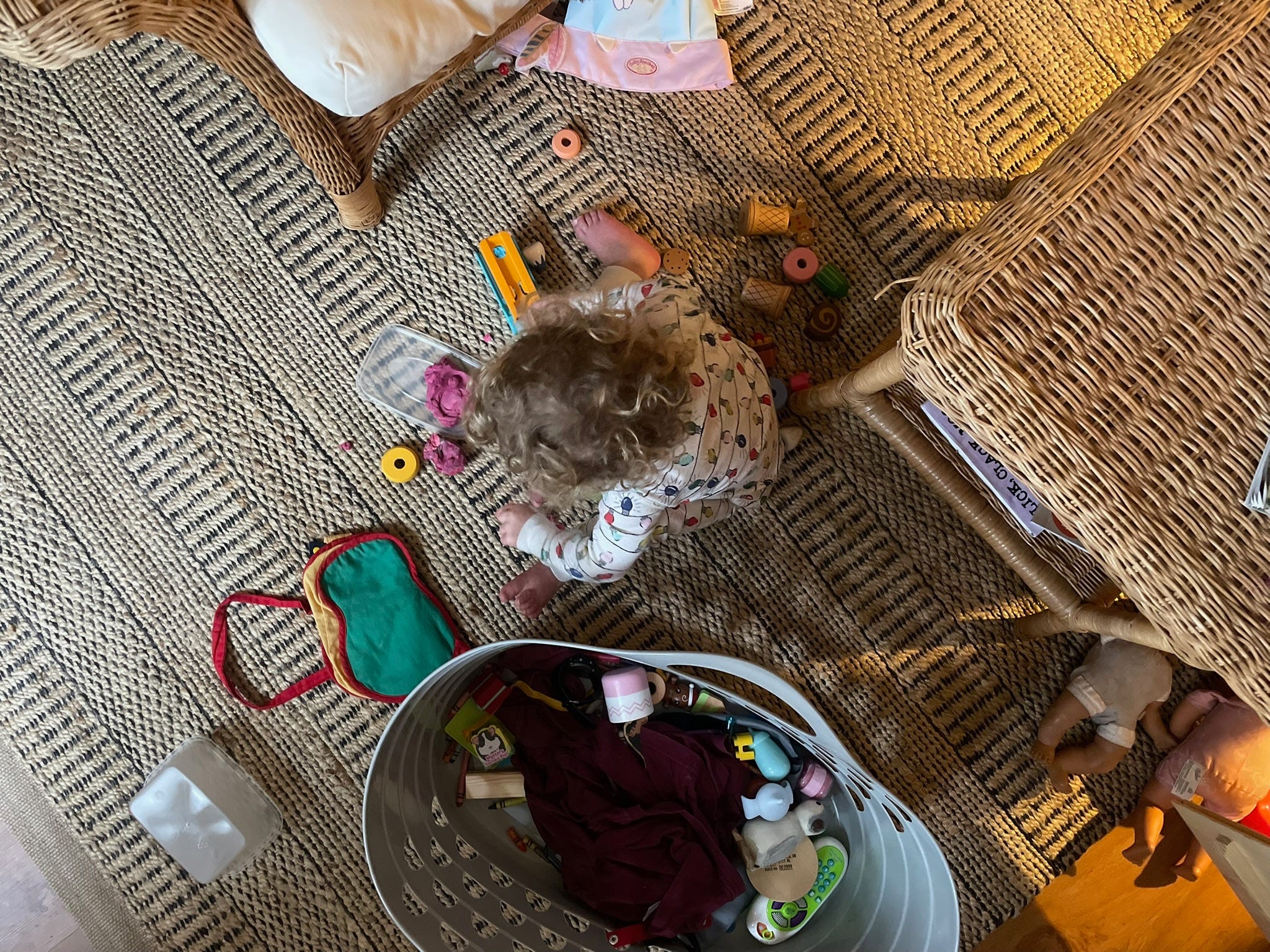
“Doing the robot” to my daughter is, like almost everything in her life, ritualistic. The first thing to know is that she will not — will absolutely not under any circumstance — touch the floor while Floris is working. If the house were on fire or there were a pile of chocolate biscuits in the next room or there were an all-night Bluey marathon happening upstairs, she would still remain confined to the sofa. So, the first step, whenever we “do the robot,” is to get her on the sofa. She’ll usually insist on bringing some toys with her. While the robot cleans, she’ll systematically sacrifice each of them by throwing them on the floor in the robot’s path. “Daddy!” she’ll yell, “the robot’s gonna get puppy!”
But it is not just a matter of getting her on the sofa and turning Floris on. There is a whole setup she expects first, starting with routine maintenance.
It was obvious to me, when I got a robot vacuum cleaner, that I’d have to do some level of maintenance. Maybe I didn’t correctly estimate how dirty our house is, or I underestimated how good Floris would be at finding dirt, but, either way, our little robotic servant gets filthy. He also occasionally gets all clogged up on pieces of string, dog hair, and throw-rug fluff. So, every so often I inspect his innards for debris. Felicity calls this, “fixing the robot,” and she demands I do it before we turn him on. She’ll sit on her sofa and oversee this pre-clean maintenance procedure. Her primary concern is that I do it in the correct order: first, I remove him from his house; then I doff his “helmet,” which is really just a decorative plastic cover that sits atop his chassis; then I have to take out his dustbin and bring it to the kitchen; then I have to reinsert his dustbin and take out his “bottom,” which is really just his little mop tray and bring it to the kitchen; finally, I must put everything back together and slide him back into his house. However, I cannot yet press the button because, paradoxically, she likes to do it.
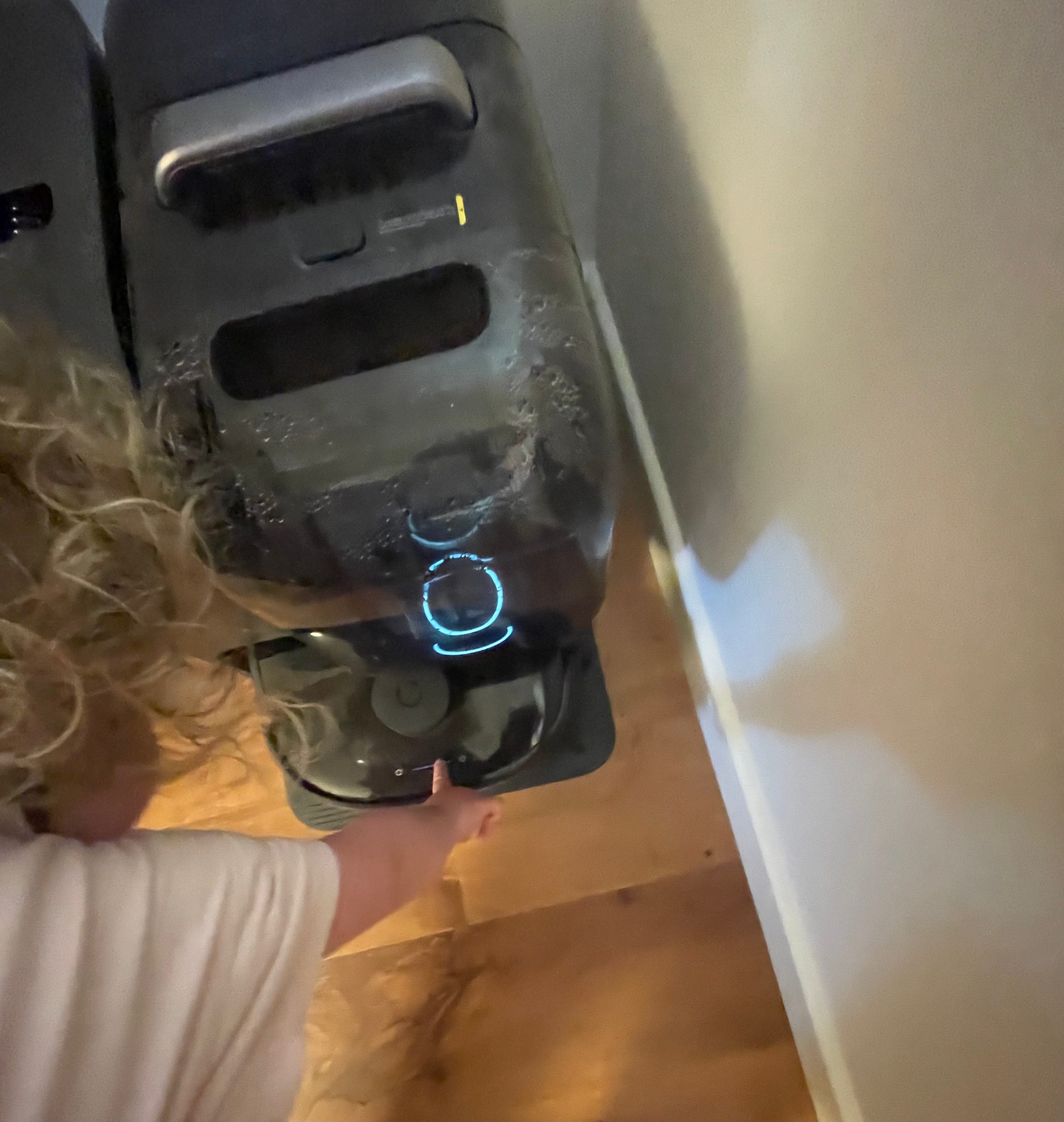
I suppose it’s common to be fascinated by things that frighten us. It’s just weird to see this firsthand in the ways my daughter interacts with Floris. She wants to touch him, she wants to go on the floor while he’s vacuuming and bother him, she wants to be his friend — but she literally can’t. Still, she insists on pressing the button, which is on the equivalent of his nose, but as soon as we start the whole robot ritual, the floor becomes lava. As such, I have to carry her in a Superman pose over to the robot’s house and dangle her, Mission Impossible style, over the robot and lower her down so she can touch his power button. Then, as Floris announces “Begin cleaning,” we have to rush back to the safety of the sofa so she can spectate. She will not leave the sofa until the robot finishes. This, for me, is a much-valued form of freedom.
The cleaning process takes about 25 minutes. This is the only version of a guilt-free, technological babysitter modernity has to offer. She isn’t staring at a screen or making a complete mess of something, but she is nonetheless voluntarily confined to the sofa. For 25 minutes, while Floris works, I can do whatever I want: the dishes, some laundry, have a snooze, take a quick flight to Ibiza. The only snag (there’s always a snag) is that, while Floris is busy babysitting, Floris himself needs babysitting. His problem is that he gets hung up on things like carpet tassels and shoelaces and cords. Felicity knows this can happen, and, like a fan watching a NASCAR race waiting for an exciting crash, it only adds to her amusement.
“Daddy!!” she’ll call from her sofa-prison, “Daddy! The robot’s stuck!” Then, my phone will vibrate to tell me the robot is stuck. Then, the robot himself will say “The robot is stuck, please remove obstruction” (yes, he always uses the third-person). When I come downstairs, or from the other room, to find the robot, he’s usually managed to wind something around his brushes. Extricating him means dismantling him enough so that, when I flip him over, he doesn’t leak disgusting mop water all over the floor. While my daughter cheers me on, I’ll unwind whatever he’s managed to get caught up in his brushes or mop.
Robo-Stuck
One positive externality of having an expensive, cumbersome, loud, toddler-terror-inducing robot vacuum cleaner is he forces us to tidy. Partly out of respect for Floris, and partly out of being proactive about avoiding him getting caught up on some obstacle, I usually do a ten-minute tidying spree before activating him. Chairs (yes, we have chairs now) go on tables, carpet tassels get rolled up, toys get thrown in a cupboard, lamps get elevated, cords get coiled. But, like with my child, Floris has a knack for getting himself into trouble. The most heartbreaking was when I did my ten-minute tidying session, turned him on, then left the house for the day. About five minutes later, I got a notification on my phone telling me Floris was stuck.
Before you think I’ve gone completely insane, it might be worth explaining my and my wife’s relationship with Floris. Whereas Felicity is terrified of him, we love him like a pet. He might be a bit hapless, but he’s doing his damned best to fulfill his purpose. Plus, he does funny shit. If he’s working and you’re sitting at a desk, say, writing an essay about robot vacuum cleaners, you will inevitably feel little whiskers ticking your ankles. For whatever reason, his LiDAR guidance is sufficient at keeping him off walls and furniture, but the human foot may as well be invisible to it. Once, we left our back door open and my wife caught him trying to vacuum our back yard. She had to carry him in like a runaway cat. Because we anthropomorphize him, this all gets interpreted as little quirks of a hardworking laborer trying to do his best. Thus comes empathy and kinship.
So, when I had to spend a whole day out knowing poor Floris was trapped, I was devastated. Trapped? I thought. Where? Did I leave a door open? Did the roof cave in? Did he lock himself in the bathroom? Is he sad? When I got home, I immediately searched the house. I found him under the dining table, cordoned against the wall by the edge of the rug I had rolled up. I am not sure how he got in this position, but when I finally got to him, his batteries were depleted from spinning around in circles trying to escape his throw-rug prison. I carried him back to his little mansion so he could be nursed back to health.
Such is the endless drain of ownership.
Keeping The Outside Out
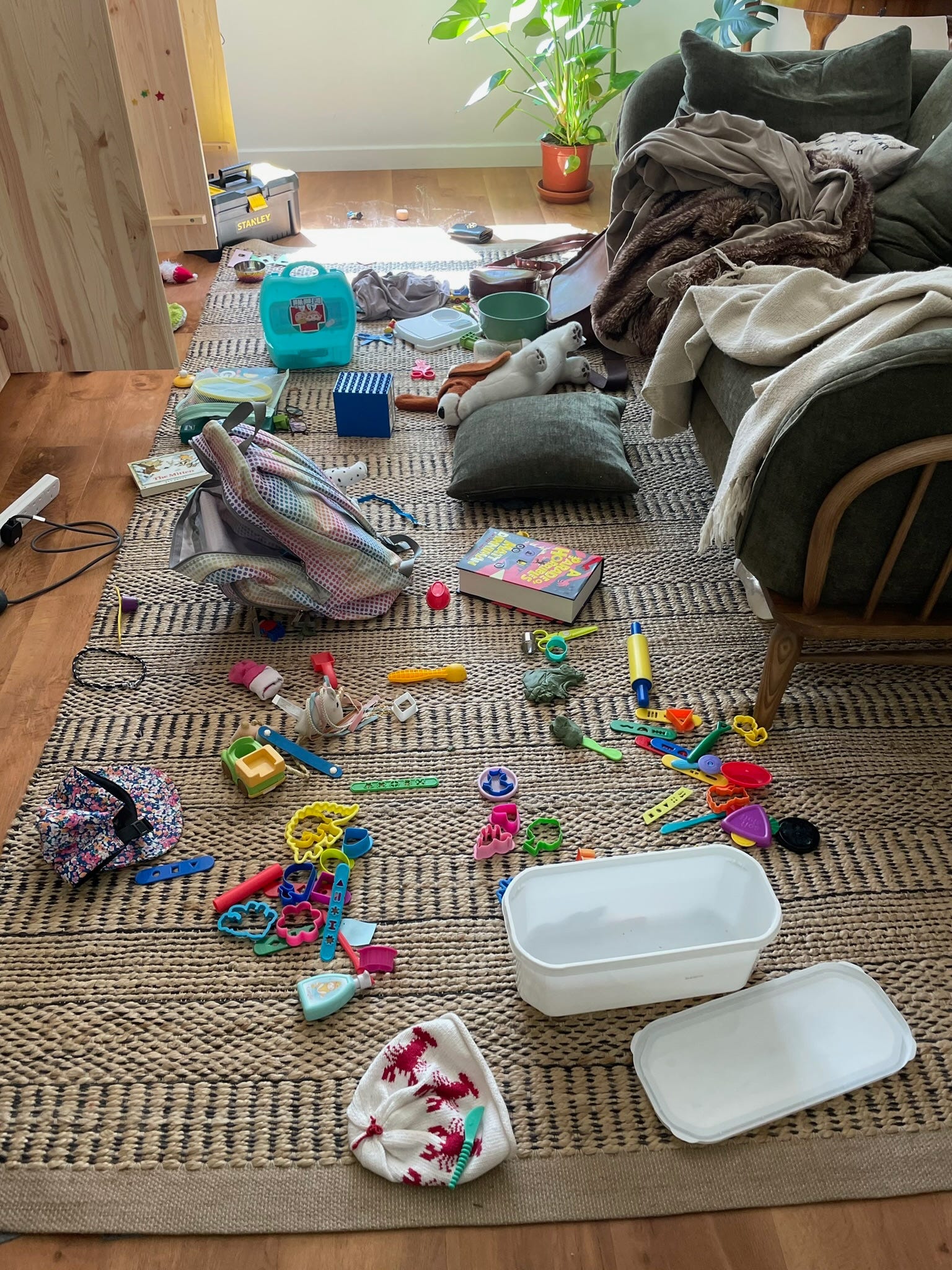
Like a lot of Americans, I hate things, but I also love things. I especially love things that make taking care of other things I bought easier. Oh, and things that can make buying other things easier? Sign me up. Yet, quite a lot of domestic sadness, I imagine, is easily attributed to the accumulation of things, and things’ accumulation of dirt
Henry David Thoreau might be America’s greatest contribution to philosophy.2 His best work is probably Walden, and my favorite part of it is when he talks about dirt:
I had three pieces of limestone on my desk, but I was terrified to find that they required to be dusted daily, when the furniture of my mind was all undusted still, and I threw them out the window in disgust. How, then, could I have a furnished house?
How, indeed? This is the paradox of the homeowner. We bring burdens into our home that merely accumulate dirt. Dirt creates either anxiety when we leave it alone or tedious work when we finally decide to do something about it. Yet, accumulation of objects, and thus dirt, and thus work, remains the modern domestic meta game. Thoreau figured this out 100 years before industrial capitalism really got going, and he still ran off to the woods.3 Now, our houses are fuller and dirtier than ever, leaving us with little time, in the words of Thoreau, to dust our minds.
Mary Douglas is often credited with pithily defining dirt as “matter out of place.”4 This is a mostly workable definition for the kinds of things in our houses we call dirt. The only problem is it’s a bit too sympathetic to the dirt, as if the bits of soil and leaves that are so infatuated with my house are somehow victims. I refuse to think of dirt as some wayward traveler who’s “out of place” in my home. It’s more like an obsessed fan constantly finding new ways to harass me in the place I’m supposed to feel safest. The dirt, in other words, is always exactly where it wants to be.
Still, we can utilize Douglas’s definition to better understand domestic life. It’s all about trying to get dirt back to its correct place. Whether I’m soaking soiled toddler clothes, sweeping up flour from a failed pasta-making experiment, or picking up another fucking leaf my dog dragged into the kitchen, all I’m really doing is evicting unwanted matter squatting in my house. For an actual eviction, you bring the sheriff along; when I’m expelling dirt, though, I send Floris. The problem is that Floris, one way or another, is himself a catalyst for dirt.
Floris does a good job, don’t get me wrong. He’s a bit high-maintenance, and a bit loud, but he more or less comes as advertised. However, there are places in our home his anatomy simply won’t let him reach. Corners, for instance, require manual intervention, as do the endlessly spawning lattices of dust that develop atop the various nests of cords that populate our downstairs.5 But, even if Floris could somehow clean these things, it wouldn’t matter.
Another characteristic of dirt Douglas’s definition precludes is its tendency to manifest in harder and harder to reach places as you clean the easier stuff. In other words, if you just leave your floor un-vacuumed, you merely have a dirty floor. This is unpleasant, for sure, but somehow manageable in its plainness. Once you vacuum the floor, though, you don’t actually have a clean floor: you have dirty baseboards. And, once you clean those, you now notice the dusty picture frames. Dust those frames, and the cobwebs in your lamps reveal themselves. Clean those and you’ll find the fly graveyard in your window sill. Exhume the flies and, hey whaddaya know, there’s a weird stain on the ceiling. Erase that, and you’ll see the film that’s developed on the kitchen cabinets. A quick scrub there merely reveals the greasy oven. Scrape that clean, and you’re now looking at a crusty microwave. De-crust the microwave, and you’ll start vacuuming out your PC case and plucking crumbs out of the seams in your kitchen table. By the time you get to everything (which time, by the way, may never come to pass), it’s time to clean the floors again.
Work begets work and so do the machines to which we outsource it. Thanks to Floris, I no longer have to personally vacuum twice a day, but he’s done little to ease the amount of toil inherent to domesticity. Floris isn’t unique in this way. Our lives are filled with machines that, ostensibly, reduce menial labor. I load my dishes and laundry into a machine, I cook my rice in a machine, I cut my lawn with a machine, and I drive to an impossibly well-stocked supermarket in a machine. But what am I to do with all this free time? Does it even exist?
Thoreau well understood the false promises of machine convenience:
I have learned that the swiftest traveller is he that goes afoot. I say to my friend, Suppose we try who will get there first. The distance is thirty miles; the fare ninety cents. That is almost a day’s wages.
…
Well, I start now on foot, and get there before night; I have travelled at that rate by the week together. You will in the mean while have earned your fare, and arrive there some time to-morrow, or possibly this evening, if you are lucky enough to get a job in season. Instead of going to Fitchburg, you will be working here the greater part of the day.
The convenience of technology, to Thoreau, was mostly an illusion. Yes, trains move us around quickly, he reasoned, but what are the costs? And where the hell do we even need to go? Likewise, I look at my washing machine and say, “Look at how easy it makes washing clothes!” Then, I fill up my closet so much that the machine is always running and I’m always folding and ironing. Similarly, my car can get me places in a hurry, so I must go to more places, buy more fuel, and change more oil. My little robot cleans the floor, but now I have to clean him. What a brave new world we live in: cleaning the cleaner instead of cleaning the object.
Movement as Progress
I wonder often what techno-progress is actually progress towards. What problems did all the famous techno-marvels even solve? This seems like a silly question because so much technology is so ubiquitous — and their function so obvious — their purposes stare us in the face. But, take cars for an example. It seems to me we only need cars because we have them: they didn’t help us get to faraway places but rather made places far away. It’s perhaps ironic that the car became a symbol for America’s trademark brand of mobility-based freedom while simultaneously strapping the nation with suffocating debt.6 The story is the same for other technologies: a new doodad comes along with a solution, and marketing teams invent the problem.
But this, I suppose, provides an answer to my question about progress. Cars and phones and washing machines and Kindles and LLMs and smart watches and bar codes and, indeed, robot vacuums all end up solving the same problem: how can we increase consumption?
That said, you can pry my robot vacuum cleaner from my cold, dead, consumerist hands. I can’t pull a Thoreau and throw my vinyl floors out the window nor move to a small cabin by a pond. Besides, it wouldn’t matter if I could. Floris is part of the family now. It’s not his fault he’s a product of and for consumption — just like it isn’t ours.

Hey, thanks for reading. If you like my stuff, consider subscribing.
You can call him anything besides Roomba. He’s not a damn Roomba.
Don’t shoot, Chomsky, Baldwin, Rawls, and Du Bois fans.
I know he didn’t live there forever, and yes, I know he wasn’t all that far from town, did his laundry at home, and went to the store to buy the newspaper. Still, read the book. It’s really good.
Finding the origin of this definition is an exercise in frustration. People commonly credit it to Mary Douglas, but in her own book she calls it an “old definition.” It seems likely that a version of this phrase was coined by somebody called Lord Palmerston, but he himself, when using a similar phrase, said he had “heard it said.” I don’t have time for this rabbit hole. Besides, Douglas made it popular, so I’m going with the status quo here.
Something needs to be done about how many things need to be plugged in or charged in the modern home. We have phones, flashlights, laptops, headphones, iPads, headlamps, and kindles that all require cords.
Seriously, read this study. It’s eye-opening.
I found myself falling a little bit in love with Floris reading this. It’s impossible not to relate! We’re all just out here just trying our best but inevitably find ourselves stuck on the edge of a rug, asking for help ❤️ great read!
I prefer the government name, although I would shorten it to E28. I am a Star Wars fan after all.