
Changing Tastes: The Lorax
Or My Ever-Evolving Hatred for The Once-ler

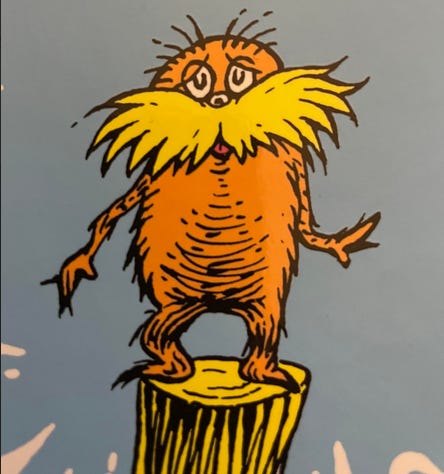
Hey. This is the second part of a series on how my toddler has changed my opinion on things. If you enjoy it, please consider using the like button or leaving a comment. If you really wanna go the extra mile, consider subscribing. Every little bit helps.
Cheers!
Every so often I find myself eager to be annoyed. I’m not sure why this happens. Maybe my life is too easy or too boring. Regardless, a proven way to fulfill this desire is to read bad reviews of things I love: movies, TV shows, robot vacuum cleaners, and, of course, children’s books.
Reviews for books like The Giving Tree and I Want My Hat Back are particularly annoying. What angers people (whose anger then angers me) about these books is that they lack the moral purity and simplicity our culture has come to expect in kids’ literature.1 While most people can handle a bit of humor or moral ambiguity, people who write one-star Amazon reviews for picture books cannot. Some people actually get so worked up over certain children’s books they rewrite them.
Screenwriter Topher Payne, for example, has a whole series called “Topher Fixed It,” in which he rewrites the endings of unpalatable children’s books.2 In these re-imaginings, Rainbow Fish keeps his scales and The Giving Tree learns to say no. To be clear, it’s not Payne’s rewrites themselves that bother me: they support charity, and, importantly, they’re funny. What does annoy me, though, is people who really do think the books Payne parodies need “fixing.”
Emily Temple, writing about The Giving Tree for Literary Hub, captures this strange feeling perfectly:
...a tree gives up every molecule of itself to help some ungrateful kid, and we’re supposed to think it’s good and noble or something.
No. You are not supposed to think that. The tree–boy relationship as portrayed in the book is undoubtedly toxic, but where exactly does it say that the relationship is noble or good? The Giving Tree only becomes problematic if we believe (1) that books contain something called a “message” and (2) that whatever message a book is trying to transmit comes only from the book itself. Does a book really need to end on its last page? Can we bring nothing to a story?
Still, I can understand why people are upset enough with The Giving Tree to want to rewrite it. I was, however, surprised to find that another classic has been the target of an angry rewrite.
The Lorax is one of his Dr. Seuss’s great achievements. It’s got everything one would expect from Seuss: surreal art, memorable characters, and a fantastical story told in galloping anapestic tetrameter. Unlike his more whimsical books like The Cat in the Hat, The Lorax has a tangible, political agenda. But, given that this agenda is environmental in nature, one would think the story would be universally palatable, much like his other beloved classic Oh, the Places You’ll Go. Who, after all, doesn’t want to save the trees?
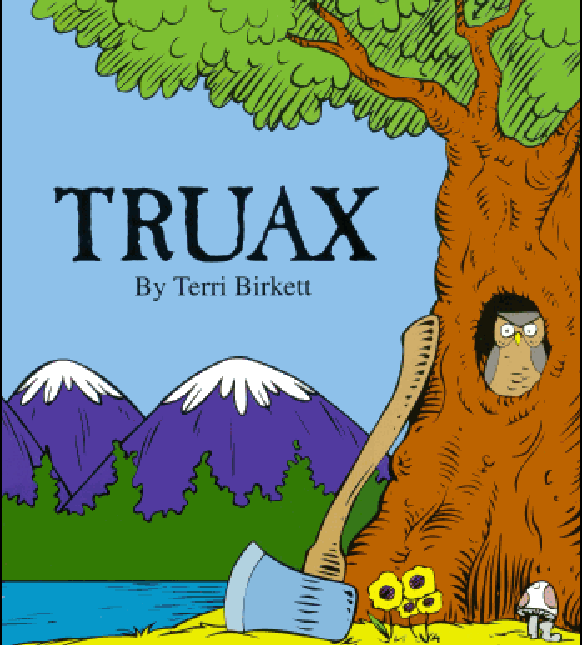
Terri Birkett, that’s who. In 1994 the self-proclaimed “active member of the hardwood flooring industry” wrote Truax, an illustrated response to The Lorax.3
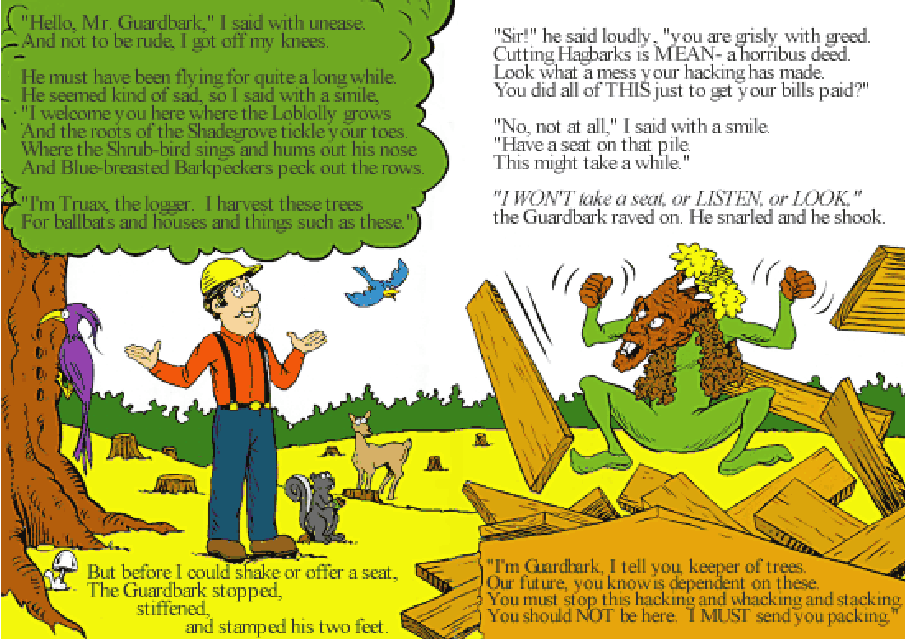
Apparently, Birkett saw Dr. Seuss’s famous environmentalist plea and took it personally. Her book re-frames the greedy Once-ler as a happy-go-lucky environmentalist logger named Truax and the Lorax as a hapless, moronic, “guardian of the trees” named Guardbark. The two argue until Guardbark is set straight. The forest, Truax argues, is actually better off with the logging industry. Who knew?
Here’s how the hero, Truax, responds when Guardbark asks him about endangered species:
Would any one mind if we lost, say, a tick
That carried a germ that made Cuddlebears sick?Or what about something that’s really quite nice
Like the Yellow-Striped Minnow that lives in Lake Zice?
How far will we go? How much will we pay?
To keep a few minnows from dying away?Do we ever consider just how it would be
If we could NEVER, EVER again cut a tree?4
The whole book is like this: silly straw-man arguments and false dichotomies. But books and critiques like this are worth paying attention to because they tell us something about how our culture reads children’s books. We expect them to moralize, but our toolkit for extracting those morals is ever-dwindling. Put simply, we’ve come to expect a story’s conclusion to represent the author’s opinion on how the world should be.
I should know: I used to despise The Lorax.
Of course, I didn’t hate it because of its environmental agenda.5 I hated it because I was more like the people who stay up late and complain about The Giving Tree on Amazon. I thought, foolishly, the book’s moral core was rotten.
What annoyed me was the Once-ler. The problem is he isn’t a simple villain. He starts off that way, exploiting the forest and “biggering and biggering and biggering” his wallet, but by the end of the book he actually understands why what he did was wrong. This is where Seuss made, what I used to consider, a poor decision. While the Once-ler grew enough to recognize his crimes, he didn’t grow enough to hold himself accountable for them.
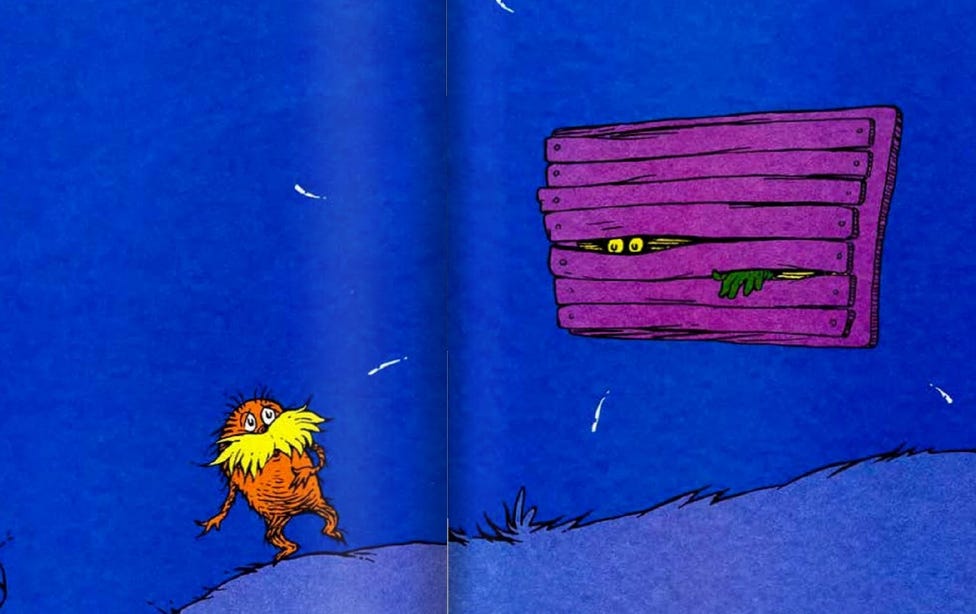
Instead, Seuss gives us this unforgettable page:
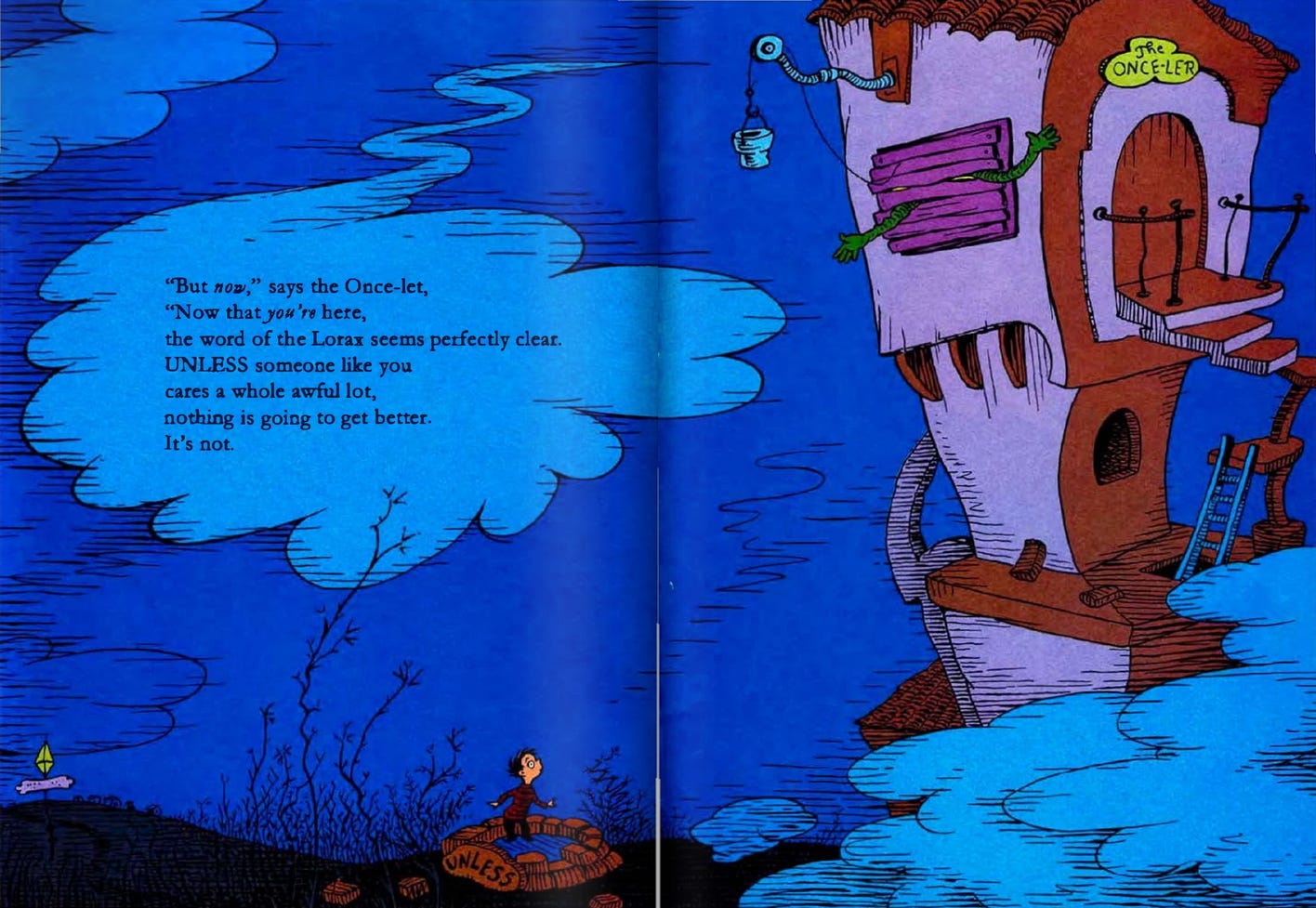
I couldn’t believe Seuss would allow the Once-ler to pass the buck like this. This dude was alive all this time — is still alive — and yet all he can manage to do is thrust the sacred responsibility of rebuilding an ecosystem upon a boy (and a generation) who played no part in its collapse?6 And we’re supposed to walk away feeling empowered? And this is somehow noble and good?
I realize now, after having contributed to the next generation, how stupid that interpretation is. Not only did I commit the same sins I now condemn in others, but I also missed the point: the Once-ler doesn’t change. He remains a greedy, ugly recluse who refuses to take responsibility for his actions. His problem was never ignorance, so he cannot be redeemed through awareness.
To put it another way, I used to think the Once-ler was a coward and that Dr. Seuss failed in writing a redemption arc. But Seuss probably never intended to redeem the Once-ler. His crime — in addition to deforestation in the name of profit — is inaction. The Once-ler got his. He made his money. He doesn’t give a shit about the forest any more now than he did before. The most he’s going to do is encourage somebody else to fix it and then retreat to his tower.
Much like The Giving Tree, The Lorax refuses to show us how things ought to be, and instead shows us how things are. The Once-ler should care, but he doesn’t. Thus, the burden falls upon those who shouldn’t have to bear it, but do. It’s simple, but getting there requires setting aside the implicit belief that the conclusion of a story constitutes an authorial statement on how the world should be.
It’s embarrassing it took until my 30s to figure all this out. I’m sure it came quicker to others. Still, the difference between “the environment is your responsibility” and “the environment is your responsibility because the people who fucked it up aren’t going to do anything about it” is not trivial. There are two separate problems being condemned here. What’s even more important, though, is that reading the book this way makes the Once-ler a much scarier villain because it makes him realistic — maybe even familiar.
Millennials have good reason to be angry with our parents and grandparents, much like the boy has cause to be angry with the Once-ler. Still, one is left wondering how we’re going to explain to our children all that went wrong under our watch. The last Millennial turned 18 in 2014, while Zoomers only have another four years left to claim innocence. What happens when canonically victimized generations like ours revisit this book and start seeing ourselves not as the boy but as the Once-ler? What happens when yet another generation refuses accountability? What will we say when our kids ask us about the 2020s?
The Lorax is a terrifying book to parents because it makes us consider the distribution of blame, responsibility, and accountability across generations. In a perfect world, these all fall on the same side; in the real world, however, the old eat the young.
Given all this, I no longer think Seuss was writing to inspire or empower young people. Thus, I no longer hate the book.
But it isn’t just a matter of preference or opinion. There is real danger in viewing this book as a mere call-to-action aimed at your kids. This reading, more or less, lets the Once-ler — and, consequently, parents — off the hook. This isn’t just theoretical, either. People (myself included) mess this up all the time. Hell, the back of my copy of the book has the following blurb:
Timely, playful, and hopeful, it teaches that just one small seed — or one small child — can make a difference.
No. It teaches that one small child will have to make a difference.
Those are not the same thing.
Hey, thanks for reading. If you like my stuff, consider subscribing.
A strange impulse given our kidlit canon is built upon morally dubious fairy tales that often involve child abandonment, cannibalism, and murder.
To be fair to Topher, he admits on his website that "Fixed" is in jest. They are more like explorations of what these books could have been. A bit like, say, Pride & Prejudice & Zombies.
Her name is Terri Birkett, and she speaks for the hardwood flooring industry!
Sorry, endangered animals. The spice must flow.
I’m not, after all, a paid hardwood-flooring lobbyist
Not to mention the fact that he literally had the Truffula seed with him the whole time. What the fuck was stopping him from planting it?
I honestly never gave the Once-ler much thought until now. But you are right, he hasn't changed has he? I am guessing he's not rich - his business likely collapsed when the last truffula fell? I guess the key detail is he charges the kid to hear the tale, which means he's still a meanie.
Interesting. I'm going to give this a lot of thought.
😍